AAMAS 2026 Competition:
|

|
AAMAS 2026 Competition#
Welcome to the AAMAS 2026 Non-Stationarity Challenge Page! This competition, co-located with AAMAS 2026, invites researchers and practitioners to develop and evaluate decision-making agents that can effectively adapt to non-stationary environments using the NS-Gym framework. Participants will design agents capable of detecting, adapting to, and recovering from dynamic environmental shifts. The solution method is open to any approach, including but not limited to reinforcement learning, online planning, meta-learning, and continuous learning. The competition aims to foster innovation in adaptive decision-making and provide insights into the challenges of non-stationary environments. Results will be presented at the AAMAS 2026 conference.
If you are interested in participating and would like to be directly notified of updates, please fill out this interest form.
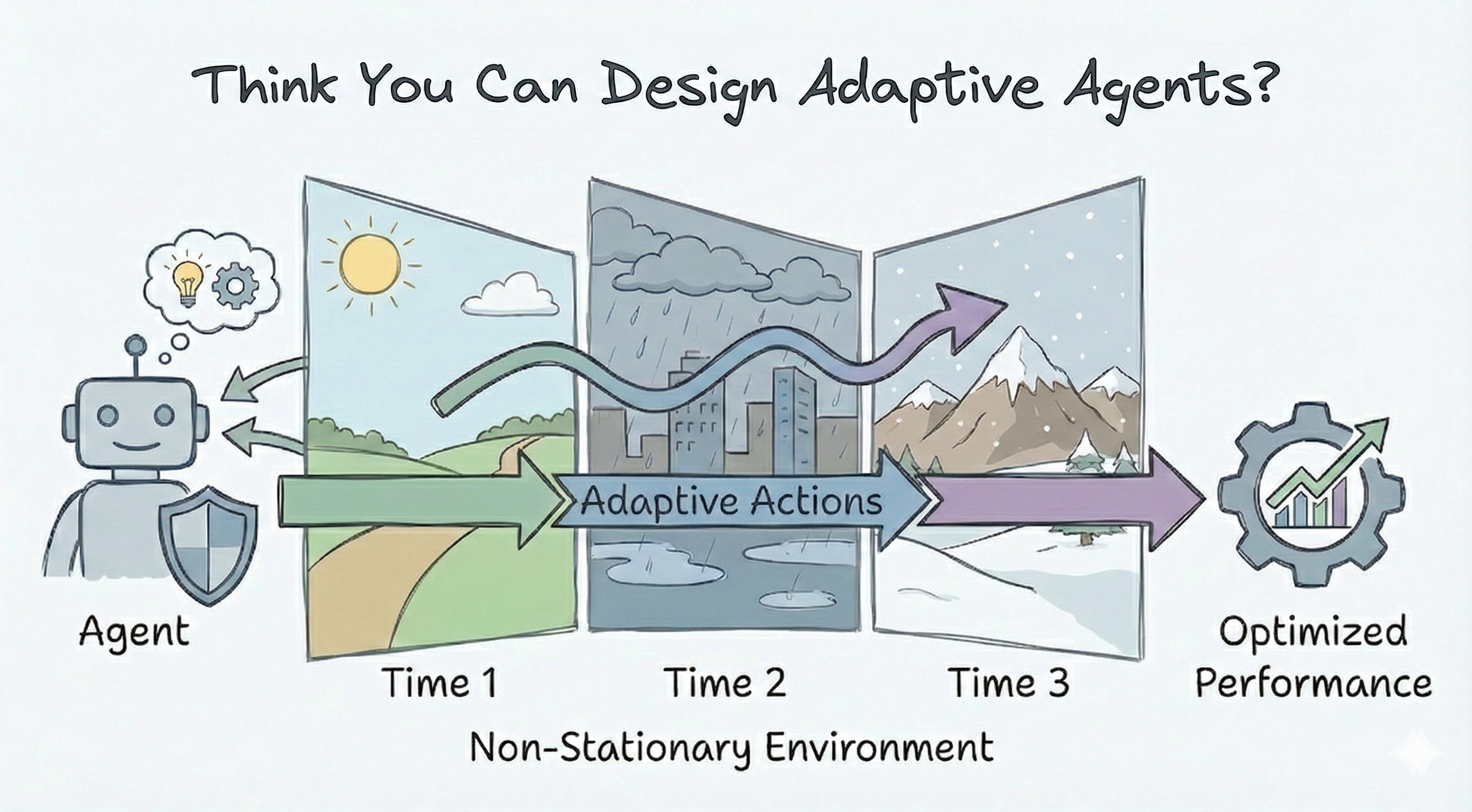 Graphic Generated by Gemini Nano Banana Pro
About AAMAS 2026#
The 25th International Conference on Autonomous Agents and Multiagent Systems (AAMAS 2026) will be held 25–29 May 2026 in Paphos, Cyprus.
AAMAS is the largest and most influential conference in the field of agents and multi-agent systems, bringing together researchers and practitioners across all areas of agent technology and providing an internationally renowned, high-profile forum for publishing and discovering the latest developments in the field. AAMAS is the flagship conference of the non-profit International Foundation for Autonomous Agents and Multiagent Systems (IFAAMAS). You can view a list of past AAMAS conferences here.
Important Dates#
All times are AOE.
February 5, 2026: Baseline Competition Code Release and Submission Portal Opens
January - April 2026: Submission period with open leaderboard and Q&A forum
May 10, 2026: Final Submission Deadline
May 25-29, 2026: AAMAS 2026 Conference (Paphos, Cyprus) and presentation of competition results
Competition Tutorials#
Use these guides in order:
Office Hours#
We will be hosting weekly virtual office hours over Zoom on an alternating schedule to accommodate participants across different time zones:
Session A: 8:00 AM – 9:00 AM (CST / UTC-6) February 25, March 11, March 25, April 8, April 22, May 6
Session B: 8:00 PM – 9:00 PM (CST / UTC-6) March 4, March 18, April 1, April 15, April 29
NS-Gym NeurIPS Paper#
For more information about NS-Gym and the underlying framework for this competition, please refer to our NeurIPS 2025 paper: NS-Gym: A Comprehensive and Open-Source Simulation Framework for Non-Stationary Markov Decision Processes.
@inproceedings{
    keplinger2025nsgym,
    title={{NS}-Gym: A Comprehensive and Open-Source Simulation Framework for Non-Stationary Markov Decision Processes},
    author={Nathaniel S Keplinger and Baiting Luo and Yunuo Zhang and Kyle Hollins Wray and Aron Laszka and Abhishek Dubey and Ayan Mukhopadhyay},
    booktitle={The Thirty-ninth Annual Conference on Neural Information Processing Systems Datasets and Benchmarks Track},
    year={2025},
    url={https://openreview.net/forum?id=YOXZuRy40U}
}
NS-Gym Installation#
To get started with NS-Gym, please follow the instructions in the NS-Gym quickstart guide to install the package and set up your development environment. A tutorial notebook for using NS-Gym can be found here.
Submission Guidelines#
Submissions will be managed via GitHub using a private repository model to ensure fairness and prevent code leakage. To participate, follow these steps:
Access the Template: Use the scope-lab-vu/ns-gym-comp-template repository. It contains instructions, boilerplate code, and the standard interface for your agent.
Follow the instructions in the template repository readme to create a new repository using the template and set your development environment.
Implement Your Agent: Develop your solution within the provided framework.
Grant Access: Once you are ready to submit, add the competition organizers, nkepling and ayanmukhopadhyay, as collaborators on your private repository.
Finalize Submission: When ready to submit, open an issue in the template repository with a link to your submission repo. Alternatively, you can email nathaniel.s.keplinger [at] vanderbilt.edu, yli113 [at] wm.edu, and amukhopadhyay [at] wm.edu to notify us that your repository is ready for evaluation.
The organizers will pull your code and conduct the final evaluation using a standardized Docker image. Results will be reported back.
Agent Interface#
Model-free agents must expose a
select_action(obs)method.Model-based agents must expose a
select_action(obs, planning_env)method, whereplanning_envis a stationary snapshot of the environment provided by NS-Gym that can be used for planning.
Evaluation Criteria#
We evaluate agents based on how well they handle the transition from a stable environment to a changed one. The scoring is aggregated across multiple environments using normalized metrics.
Adaptability: We measure the speed and effectiveness of adaptation after a change occurs. This includes the number of new environment interactions (timesteps) required and the total runtime before the agent is considered recovered.
Performance: This is calculated based on the average undiscounted episodic reward achieved under non-stationary conditions.
Resilience: We assess how well the agent recovers from unexpected shifts in dynamics. We specifically look at the magnitude of the performance drop between the stable pre-shift return and the post-shift episode return.
Efficiency: We track the computational cost of the adaptation mechanism. This includes CPU/GPU utilization per decision step and the total memory utilization across the evaluation episode.
For detailed information, see Evaluation Criteria.
Example Environments#
The competition will focus on environments that have parametric changes. The parametric changes involve gradual or abrupt variations in continuous parameters that affect the environment’s dynamics. Examples include changes in friction coefficients, mass distributions, or gravity. The magnitude and frequency of these changes will vary across different environments to test the robustness of the agents.
We will evaluate all submitted agents on a suite of non-stationary environments using NS-Gym. For each environment in NS-Gym, we will define a holdout set of non-stationary variations for testing not available to the public. Each variation will define a set of parameters to change, frequency of changes, and the magnitude of changes. For each environment we will test agents on three levels of “notification” settings.
Basic Notification: The agent is only informed that a change has occurred but receives no additional context.
Detailed Notification: The agent is explicitly informed when a change occurs and will receive additional context about the nature of the change.
Uninformed: The agent is not informed of any changes.
Contact Information#
Please feel free to reach out with any questions or concerns regarding the competition. You can contact the competition organizers at nathaniel.s.keplinger [at] vanderbilt.edu, yli113 [at] wm.edu and amukhopadhyay [at] wm.edu.